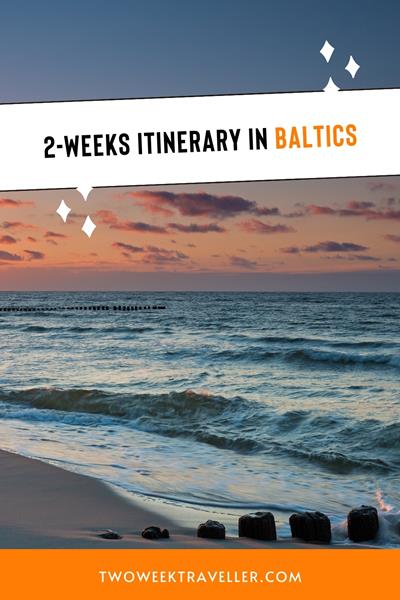
The Baltic region of Europe does not get a lot of attention compared to central, west, south, or even east Europe. Not because it lacks stunning locations, but because during World War II, the Baltic region was greatly destructed by the bombing. The countries affected have to rebuild from scratch.
Thank you for reading this post, don't forget to subscribe!Another reason is that the countries in the Baltics left the USSR (Russian Empire) not too long ago. In the 1990s, they became independent countries roughly 30 years ago. This means that the countries have yet to make their name and impact in the world.
Today, the countries in the Baltics have their own languages, cultures, cuisines, and fantastic places to showcase to their visitors. In this itinerary for 2 weeks in the Baltics, I’ll help you get a visual idea of what a trip to Lithuania, Latvia, and Estonia for 14 days would look like.
CHECK OUT: 2 weeks in Italy and 2 weeks in Spain
THINGS TO KNOW BEFORE VISITING THE BALTICS

When planning a trip to a place you have never been to, it can be intimidating and overwhelming to imagine what the place is like, how to move around, or how to get out of the airport without looking silly.
Below are some basic but important things you should know if you plan a trip to the Baltics. The following information will help you visualise your trip and prepare. These will help you write a travel itinerary that is suitable for you.
What are the countries in the Baltic Region
There are three countries in the Baltic Region. This includes Lithuania, Latvia, and Estonia. The region got its name due to the fact that these countries lie next to the Baltic Sea. This is why some resources might even say that Sweden, Finland, and Poland are also part of the Baltics.
However, Sweden is part of Scandinavia and the Nordics, while Finland is part of the Nordic region. Poland is often regarded as East Europe or Central Europe.
Regardless, in this travel itinerary, we will be focusing on Lithuania, Latvia, and Estonia.
When is the best time to go to Baltics
The best time to visit the Baltics is between spring, summer, and autumn. This region is not known for skiing or other winter activities although it doesn’t mean there’s nothing to see.
During the warmer months, you can walk around, rent a push bike, and enjoy a nicer and more comfortable visit. One thing that’s amazing in this region is the rainy season.
The wet season often happens during summer. However, the chance of rain is often no greater than 30%. This means you can be assured that your day won’t have to be cancelled due to rain.
The winter can be rough. It’s dark and cold, and most locals prefer to hide away in warmth. But during this time, there are fewer tourists and the hotel prices are often lower. There are places you can visit that are only possible or more enjoyable during winter.
You can walk on the frozen lake in Lithuania, visit a sauna in Latvia, and explore the Christmas markets in Estonia.
Are 2 weeks enough in the Baltics
2 weeks in the Baltics is plenty, you can see a few cities and cover all three countries. About 3-4 weeks would be better, but with great planning, you can cover the Baltic Region in just 14 days.
If you want to travel slowly, perhaps choose between 2-3 cities only, but if you want to see as many places as possible, you can squeeze 3-5 cities into your itinerary. Just make sure that you choose cities that are connected by bus, train, or direct flight.
If you have never been to Europe or have been but thinking of seeing a different place this time, check our compilation of different itineraries for 2 weeks in Europe, from central Europe, southern, eastern, and even up to the Nordic region.
Getting around
Moving around between Estonia, Latvia, and Lithuania is very easy. These three countries are well-connected to one another by public transport. You can travel around the region by bus, train, car, and of course, flying.
If you prefer the freedom of your time, I recommend renting a car. However, double-check if the rental company will allow you to cross the land border with the vehicle and if you can drop it off in a different country.
You can also rent a car in each country and move around with it, but it won’t help much. You can instead use ride-hailing apps and taxis, ride the bus and train, and book flights.
Taking the bus and train will be the cheapest option. The train might be faster than flying because you have to arrive at the airport with enough time before your flight. When moving around each city, you can rent a push bike or take a local bus.
Language and currency
All three countries have languages of their own. Latvian or Lettish and Lithuanian are a little similar but still very different from one another. However, their neighbour Estonia uses a Finnic language that’s more similar to Finnish or the main language in Finland.
The Baltic region uses Euro. Lithuania prefers using a bank card for payment, but cash is still preferred in smaller villages. In Latvia, paying with your credit card or debit card is also common, however, cash is mostly used.
On the other hand, Estonia is a major cashless transaction and highly promotes digital payments throughout the country.
Regardless, you’ll be able to find ATMs anywhere. It’s best to have some cash with you and try to pay with your card first. If you plan to use public transportation in Lithuania and Latvia, cash will be preferred.
What is the average cost for 2 weeks in the Baltics
14 days trip in the Baltics will cost you between $1,300 to $1,600. This will cover accommodation, transportation, a few tours, and meals, but excludes flights to and out of the Baltic region.
If you plan to spend $2,000, you should have plenty of budget and be able to spoil yourself. Just keep in mind that these numbers don’t include the main flight to and out of the Baltics.
But of course, for a luxurious trip, plan to spend about $8,000 or more if you want to stay in five-star hotels and book private and premium tours.
Visa
The Baltics are members of the EU, and are also part of the Schengen State Area, where all countries share the same visa policy and are treated as one when it comes to the number of days foreign visitors are allowed to stay.
This means that if your passport is from most countries in America, Japan, Australia, South Korea, New Zealand, Malaysia, and Singapore, you can enter and travel in the Baltics for up to 90 days in a 180-day calendar.
Other travellers must apply for a Schengen tourist visa in the embassy or consulate of either Latvia, Lithuania, or Estonia near you as soon as 6 months in advance.
Other basic travel tips
The travel sites and tools below are my favourite services to use. They offer lots of choices suitable for people on a budget or those looking to splurge a little bit. A lot of these sites also offer flexible cancellations without high fees in case your plans change.
PINNED MAP OF MUST-SEE PLACES IN THE BALTICS
Click the icon on the top right to enlarge the map. Credit: map data: Google
2 WEEKS IN THE BALTICS ITINERARY
Discovering the Baltics is quite an interesting destination. It’s less popular and with fewer visitors, yet it definitely has its own identity that’s worth discovering.
These two travel itineraries for 2 weeks in the Baltics will help you visualise what your trip could look like and help you create a travel plan that is suitable for you.
You can also check out our itinerary for 2 weeks in Eastern Europe where you’ll have plenty of choices.
Itinerary #1: First-time – Vilnius, Riga, Tallinn
If you have never been to the Baltic States, this itinerary will be perfect for you. It’s basically a route where you will visit the capital cities of the three Baltic countries.
As you traverse through each location, not only can you see the difference in the culture but also how you transition from Eastern European culture from Lithuania to a more Nordic setting as you approach Estonia.
It’s possible to simply use the train and buses to get from one city to another, but you can also take domestic flights for more convenience.
Vilnius for 5 days
Walk through the cobbled stone streets of Vilnius, dine at a local restaurant and order a tasty beer root soup matched with refreshing locally brewed cider. This is a suitable day out in Vilnius, whether it’s summer or winter.
Apart from that, you can also visit museums such as the Museum of Occupations and Freedom Fights, which showcases the occupation of Russia in Lithuania during World War II. If you are into art, explore the Museum of Illusions, Lithuanian National Museum of Art and MO Museum.
If you’re visiting in summer, make sure to do a day trip out in the Green Lakes for some swimming and boat rides. A day trip to the stunning Trakai Castle is also a must. In winter, the lake that protects the castle freezes so it’s safe to walk on it.

Riga for 4 days
Riga is the gateway to the Finnic region of Europe. Here, you will notice that the Latvian and Lithuanian languages are similar but different. However, once you cross the border to Estonia, you will see a very big difference in language between Latvian and Estonian.
Besides the fascinating language shift, Riga is also known for its lively nightlife, historical sites, and bold art scene. It’s also home to such interesting architectural progression.
Stand in a city where you will find Gothic churches, take a short walk, and you’ll be welcomed with Medieval buildings; another cool infrastructure is delivered by the gorgeous Art Nouveau style.
The must-see spots in Riga include the Central Market, House of the Black Heads, and St. Peter’s Church just to name a few. You can explore areas relating to World War II and take a day trip to Sigulda, Jelgava, and Kemeri National Park.
You can book a bus from Vilnius to reach Latvia.
Tallinn for 5 days
Do you know that Estonia is one of the least religious countries in the world? According to World Population Review, at least 60% of Estonians are not affiliated with any organised religious groups or church.
Despite this, there are still cathedrals and churches to visit in Tallinn during your visit. If this is not your interest, there are plenty of sites related to World War II where you can learn more about Estonia’s history during this time.
But one of the things that many people don’t know about this country is the fact that it has vast national parks, dense woods, and is home to unique birds.
When exploring Tallin, you definitely have to see Alexandar Nevsky Cathedral. Take a walk through the Town Hall and visit Kadriorg Art Museum. If you find yourself with some free time, get on a day trip to Lahemaa National Park, Tartu, and Jägala Waterfall & Harju County.
To get to Tallinn from Riga, you can drive for 4 hours or that the train for 5 hours. There’s also a flight you can book or the bus which is more affordable though takes longer.
Itinerary #2: Off-the-beaten-path – Kaunas, Klaipeda, Liepaja, Jelgava, Parnu
For those who want to avoid tourists, you can visit less-known cities. You might have to take a bus or train ride from the capital city to reach your destination. You may also rent a car, but if you plan to cross the border with it, make sure to check with the rental company.

Kaunas for 2 days
Take the train or bus from Vilnius to Kaunas, a city where walls are painted with incredible art. Ensure your camera is all charged up because Kaunas is a charming and photogenic location. Since it has fewer tourists, it’s very easy to take a nice shot of every corner.
The streets are paved with cobbled stone just like a truly European city. This is matched with traditional yet colourful houses. Finish your walk around by dining at a local restaurant serving Lithuanian dishes.
Klaipeda for 3 days
Klaipeda is a coastal city in Lithuania, just north of Kaliningrad. It is the oldest city in Lithuania and is known as an ice-free port, although it’s located in such northern part of Europe. Because of this, when you explore the city, many of the spots are related to history and marine life in this region.
During summer, many Lithuanians go to Klaipeda to enjoy the beach and warm weather. The locations you want to see in this city include Smiltynės Beach, Klaipeda Castle, and Lithuanian Sea Museum.
You can reach Klaipeda from Kaunas by taking a less than 5-hour train or a 3-hour bus. You can also drive, which is the fastest option for around 2 hours.
Liepaja for 2 days
It’s now time to go to Latvia. Since you are on the coast already, you can head to Liepaja, a coastal town in Latvia. Although Riga is a beach city, many locals go to Liepaja in summer, where there are fewer people during the peak season.
This town is also a known location for music festivals and concerts. Its fantastic long-stretch Liepaja Beach is perfect for enjoying the sun and reading a book. It’s also located right next to a big Seaside Park, which means the nose from the road is dampened by beautiful trees.
You can take a bus directly from Klaipeda to Liepaja, which will take around 1 hour and 40 minutes.
Jelgava for 4 days
Jelgava is less than an hour’s drive south of Riga. It’s a popular spot for a day trip from Riga due to its accessibility and cool atmosphere. Although not too far from the capital city, Jelgava is a nice town where you can still stay away from big crowds of tourists while admiring the Baltic culture and scenery.
While exploring, make sure to check out Jelgava Castle, St. Trinity Church Tower, and take a walk on the scenic wooden boardwalk in the beautiful River Svete.
Getting to Jelgava from Liepaja is not a problem. There’s a direct train, and the journey is about 2 hours and 40 minutes, the ticket will cost between $5-$10. You can also take the bus, which is cheaper but will take longer since it will stop in Riga and you need to switch buses.

Parnu for 3 days
Parnu is north of Riga, a great place as your next and final destination during your 2 weeks in the Baltics. It’s a quiet little town where you can enjoy the peaceful beach called Parnu Beach. There are not a lot of things to do in Parnu. However, this is the gateway to the incredible Sooma National Park.
If you like the outdoors, you definitely have to spend most of your time in Sooma National Park. It is a wetland and a perfect location for canoeing, bird watching, and long walks.
Sooma is only half an hour’s drive from Parnu, or you can take the local bus. Check the bus schedule since it doesn’t go that often.
THINGS TO SEE AND DO (each city)
Now that you know which cities you want to include in your 2 weeks in the Baltics itinerary, it’s time to show you a great list of must-see places in each city. This will help you visualise how you want to explore each city or the order of the places you want to go to.
Vilnius, Lithuania
- Discover Vilnius via a walking tour or bike tour
- Gediminas Castle Tower
- Jewish Quarter and Soviet Sites
- Vilnius Cathedral
- St. Anne’s Church
- Hill of Crosses – day trip from Vilnius
- Gates of Dawn
- Hot air balloon over the city – read the reviews
- Museum of Occupations and Freedom
- Cathedral Square
- Learn about Lithuanian cuisine – book a walking food tour or dinner with a local family
- Three Crosses Monument
- Palace of the Grand Dukes of Lithuania
- Full-day tour around Vilnius, to Trakai, and Keranve – check the tour price
- Vingus Park
- Walk around Uzupis – the art district of Vilnius
- Day trip to Paneriai Memorial Park – a tour that includes Trakai Castle
- Day trip to Trakai Castle – if you visit in winter, you can walk on the frozen lake to reach Trakai Castle – do an audio guide tour or one with a guide
Riga, Latvia
- Explore Riga downtown on a walking tour or Old and New walking tour
- House of the Black Heads
- Riga Central Market – go on a food-tasting tour
- St. Peter’s Church
- Beer or Cide tour – check this bike tour
- The Freedom Monument
- Latvia Palace – and medieval castle tour
- Riga Cathedral
- Day trip to Rundale Palace and Hill of Crosses – check the tour cost
- Three Brothers, Latvian Museum of Architecture
- Art Nouveau Building – sign up for an architectural bike tour
- Latvian National Museum of Art
- Go on a pub crawl
- Daugava River – go on a boat tour or this one
- Day trip to Jelgava
- Try out the shooting range – read the reviews
- Museum of the Occupation of Latvia
- Day trip to Sigulda and Turaida – look at the price
Tallinn, Estonia
- Join a city tour – either a walking tour or 2-hour guided tour or an electric bike tour or push bike tour
- Kadriorg Art Museum
- Tallinn TV Tower
- St. Olaf’s Church
- Danish King’s Garden
- Estonian cuisine – do a 3-hour food tour or a food tour with a market visit on a bike
- Alexander Nevsky Cathedral
- Kumu
- Go on a Shore Excursion – check out this tour or cruise port with a bike tour
- Tallinn Town Hall
- Estonian Open Air Museum
- Lennusadam
- Day trip to Lahemaa National Park – read the reviews
- Day trip to Parnu
- Day trip to Helsinki, Finland by ferry
Kaunas, Lithuania
- Book a Kaunas tour – check the price first
- Kaunas Castle
- 9th Fort of the Kaunas Fortress
- Devil’s Museum
- M.K Ciurlionis Museum of Art
- Explore Kaunsa, Rumsiskes, and Pazaislis Monastery – read the reviews
- Pazaislis Monastery and Church
- Laisves Aleja
- Kaunas Town Hall
- Vytautas the Great War Museum
Klaipeda, Lithuania
- Curonian Spit / National Park – do a private tour or explore on a bike
- Lithuanian Sea Museum
- Dino Parkas
- Klaipeda Castle – do a walking tour
- Smiltynes Beach
- Museum of Clocks
- Black Ghost of Klaipeda
- Canoe Tour – look at the price
Jelgava, Latvia
- Jelgava Castle
- Masti Wake Park
- Jelgava St. Trinity Church Tower
- Adolfs Aluna’s Memorial Museum
Liepaja, Latvia
- Karosta Prison
- Liepajas Muzejs
- Liepaja Beach
- Liepaja Seaside Park
- Artillery Battery No 1 (Northern Fort)
- Rose Square
- Liepaja Lake
- Liepaja Northern Breakwater
Parnu, Estonia
- Sooma National Park – book a canoe and walking tour
- Parnu Beach
- Parnu Muul
- Church of Catharina
- Parnu Museum
- Punane Torn
- Parnu Mud Baths
- Pärnu Rannapark
- Concert Hall
- Day trip to Saaremmaa Island
MUST-TRY DISHES, DRINKS, AND SNACKS

Make sure that you don’t leave the Baltics State without trying out the local cuisine. You will notice how similar many of the dishes are across these three countries. The most common that I released is the beetroot soup. All three countries have this dish and offer various versions.
Try at least 4-5 local dishes and see which one you like. I also recommend you try the cider and not forget the tasty and freshly baked pastries.
Lithuania
- Koldūnai
- Bulviniai Blynai
- Skilandis
- Šaltibarščiai / Beetroot Soup
- Cepelinai
- Kibinai
- Juoda Ruginė Duona
- Šakotis
- Alus (Beer)
- Grybai/Mushroom Cookies
- Midus
Latvia
- Aukstā Zupa – cold soup
- Sklandrausis
- Frikadeļu Zupa
- Siļķe Kažokā
- Pelēkie zirņi ar speķi
- Griķi
- Aukstā Gaļa
- Biešu Zupa – beetroot soup
Estonia
- Vürtsikilu Suupiste
- Eesti Kartulisalat
- Mulgikapsad
- Verikäkk
- Pirukas
- Rosolje
- Lillkapsas Juustukastmes
- Kringel
ACCOMMODATIONS (per city)
To help you arrange your travel plans, I included a quick list of places to stay in the Baltics based on each city. You will also see that you can choose hotels depending on your budget.
Vilnius
- Affordable: Jimmy Jumps House or Mikalo House or Downtown Forest Hostel & Camping
- Mid-range: Comfort Hotel Rock n Roll or Domus Maria or Come2Rest – Subaciaus 5 or Art City Inn
- Luxury: Hotel Vilnia or Novotel or Neringa Hotel or Radisson Blue or Congress Avenue Hotel
Riga
- Affordable: Orange Cat Rooms or Cinnamon Sally Backpackers Hostel or Blue Bird Hostel
- Mid-range: Avalon Hotel & Conferences or Wellton Riga Hotel & Spa or Hestia Hotel Draugi or Forums Boutique Hotel
- Luxury: Grand Palace Hotel or Neiburgs Hotel or Relais Le Chevalier or Hilton Garden Inn
Tallinn
- Affordable: Alur Hostel & Bar or Villa Kadriorg Hostel or Imaginary Hostel
- Mid-range: Thomas’ Home or ibis Hotel or Rija Fonnental Design Hotel or St Olav Hotel
- Luxury: Revelton Suites or The von Stackelberg Hotel or Rixwell Collection Savoy Hotel or Radisson Collection Hotel or Centennial Hotel
Kaunas
- Affordable: Mr Jo’s Hostel or Villa Kaunensis or The Monk’s Bunk
- Mid-range: Berman House or Botanical Garden Studio or Moja Accommodation
- Luxury: Moxy Hotel or Radisson Hotel or Boheme House or Kaunas City Hotel
Klaipeda
- Affordable: Surf Camp or Light House Coliving
- Mid-range: B2 Apartments or Ararat All Suites Hotel or Aurora Hotel
- Luxury: Michaelson Boutique Hotel or Victoria Hotel or Euterpe Hotel
Liepaja
- Affordable: Hotel Vilhelmine or Dzivokli Dunikas
- Mid-range: Amrita Hotel or Liva Hotel
- Luxury: Roze Villa or Promenade Hotel or Art Hotel Roma
Jelgava
Parnu
- Affordable to Mid-range: Hotel Tammsaare or Hommiku Guesthouse or Green Villa or Hotel Villa Wesset or Parnu Rannastaaddioni Hostel
- Luxury: Studio28 Boutique Rooms or Wasa Resort Hotel & Spa or Carolina Hotel
SUMMARY OF 2 WEEKS IN THE BALTICS
The Baltic State might not be a popular and glamorous region of Europe compared to the central or southern part of the country. However, it has a lot to offer. From history to cuisine, culture, and very welcoming locals.
The Baltics is a great place to visit if you want to get away from big crowds of tourists or want to experience that deep and true European adventure without spending too much and without the feeling of having to rush your trip.
I hope that you found this list of travel itineraries for 2 weeks in the Baltics helpful in planning your own travel trip.
TO SAVE THIS ITINERARY, PIN THIS IMAGE BELOW: