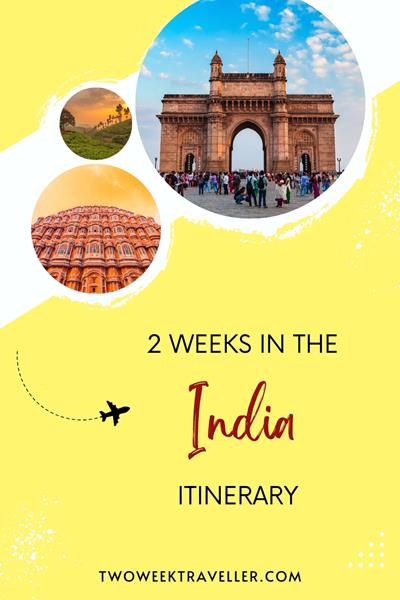
India is the seventh-largest country by area and is the most populous democratic country. It shares borders with Nepal, China, and Bhutan in the North, Myanmar and Bangladesh to the East, and Pakistan to the West. It is bounded by the Arabian Sea in the Southwest, the Indian Ocean in the South, and the Bay of Bengal in the Southeast.
Thank you for reading this post, don't forget to subscribe!It is known for its rich history, flavorful cuisine, Bollywood movies, cultural landmarks, lively celebrations, and much more. It is also famous for yoga retreats and its cuisine, among other reasons.
The Golden Triangle is a famous tourist circuit in India, connecting Agra, Jaipur, and New Delhi. It was coined because of the triangular shape the locations form on the map.
This article has 3 travel itineraries for spending 2 weeks in India. Showcasing where to go, how many days to spend, travel tips, and so much more.
ALSO READ: 2 weeks in Nepal and 2 weeks in Sri Lanka, which you love this region of Asia
BASIC TRAVEL INFORMATION FOR INDIA

India is a massive destination to explore. The regions offer different experiences and feature various temperatures. This is why it’s important to research and find basic but vital information. Below are some travel tips to get you started when creating a travel itinerary.
When is the best time to travel to India
The time to travel to India is between October and March when the weather is cooler and more comfortable for sightseeing. Many festivals like Diwali, Holi, and Pongal occur during these months, offering a rich cultural experience.
The peak and busiest season is from December to February, especially in popular destinations like Goa, Kerala, and Rajasthan. During this time, you can expect higher prices for accommodations and flights.
The summer months in India, from April to June, which can be scorching hot, with temperatures soaring up to 40°C or more in some areas. However, hill stations like Shimla, Manali, and Ooty provide a cooler retreat.
The monsoon season usually arrives between July and September. While the rains bring respite from the heat and add a lush, green charm to landscapes, it may not be the best time for outdoor activities due to frequent downpours.h
Are 2 weeks enough for India
Maybe. India is huge country with many cultures, traditions, and beautiful attractions. If you plan well, 14 days in India can be an exciting and memorable trip. One of the top things to keep in mind is choosing the mode of transportation to avoid spending too much time in airports, trains, and buses.
How to get around
There are many ways to get around India. For long distances, flying is the quickest way to travel. India has a well-connected network of domestic flights linking major cities. However, it can be pricey and not give you the “local” experience.
Trains are a cost-effective and quintessentially Indian way to travel. The country has an extensive rail network, and while it may not be the fastest, it’s quite efficient and scenic. Buses are another budget-friendly option, especially for short distances.
Ride-hailing apps like Ola and Uber are available in many Indian cities and are a convenient way to get around. They’re generally safe and offer various options, from economical to luxury rides.
In cities, auto-rickshaws and cycle-rickshaws are common and affordable but negotiate the fare in advance. Many cities also have metro systems, which are clean, fast, and relatively cheap. For the adventurous, renting a motorcycle or scooter can be an exciting way to explore, especially in hilly regions.
Language and currency
The main languages in India are Hindi and English, with Hindi being the first language for about 41% of the population. English is widely used for business, education, and is a subsidiary official language.
India is also home to 21 other officially recognized languages and hundreds of dialects. Tourists can generally get by with English, especially in cities and tourist areas, as it’s understood and spoken to varying degrees across the country. Signage at airports, railway stations, and tourist destinations is often in English.
The official currency of India is the Indian Rupee (INR), symbolized as ₹. While credit and debit cards are increasingly accepted, especially in cities and tourist areas, cash is generally the preferred mode of payment. Many small vendors, local markets, and rural areas may not have card facilities, so carrying some cash is advisable.
ATMs are widely available in cities and towns, though less so in remote areas. They usually offer a good exchange rate, but foreign cards might incur a transaction fee.
Paying directly with foreign currencies like USD or Euro is generally not accepted, except at some hotels and high-end stores that cater to tourists. Even then, the exchange rate may not be favourable. It’s best to convert your currency to INR for most transactions.
Visa
Regarding visas for travelling to India, it’s quite easy. Almost all foreign visitors can enter and travel around India by obtaining an evisa, valid for 3-, 60, 90, 180 days, and even for multiple years. The evisa must be obtained before your flight since the airline you’re using might ask for this.
Cost of 2 weeks in India
A $1,300 budget for 14 days in India per person is a good number. But it can easily be brought down if you plan a backpacking-style trip. Indian is an affordable destination, but there are also ways to make your trip more luxurious and comfortable if you want.
For budget travellers, daily expenses can be as low as $20–$50 per day. This includes staying in hostels, eating at local eateries, and using public transportation. A 2-week trip could thus cost around $280–$700.
If you prefer three-star hotels, occasional dining in mid-level restaurants, and using more convenient modes of transportation like taxis and domestic flights, plan on spending about $70–$90 per day for a mid-range budget. A 2-week trip would cost approximately $1,000–$1,300.
For a luxury experience, including 5-star hotels, fine dining, and private tours, expect to spend at least $110–$300 per day or more. A two-week luxury trip can easily cost upwards of $1,500–$4,200.
Travel arrangement tips
MAP OF TOP SITES AND ACTIVITIES IN INDIA
Click the icon on the top right to enlarge the map. Credit: map data: Google
2 WEEKS IN INDIA ITINERARY
I created numerous itinerary options for your 2 weeks in India. The itineraries will vary depending on your preference. If you are a first-time vacationer in this country, if you prefer slow travel, or a vacation with jam-packed activities.
However, these itineraries can be modified if you like; if you want to replace one location with another or remove it to lengthen your stay at the other location, it’s entirely up to you.
Itinerary #1: First-timer (New Delhi, Agra/Taj Mahal, Jaipur, Mumbai, Kerala)
This itinerary is perfect for first-timers because it consists of New Delhi, Agra, and Jaipur, the locations included in the Golden Triangle circuit (where the Taj Mahal is). This circuit is a well-travelled route; you’ll see various landscapes if you traverse this path.
Aside from these locations, you’ll also visit Mumbai and Kerala. Mumbai is well-known as India’s gateway; it’s caves, street food, museums, large open-air laundry, and more, while Kerala is famous for spices, houseboats, Ayurveda, and eco-tourism.
New Delhi for 3 days
New Delhi is the capital of India and part of the National Capital Territory of Delhi, where the seat of all three branches of the government can be found. This place is famous for its historical monuments and diversity and is known for its street food scene.
It is a perfect starting place when travelling because of the accessibility of the other places through a major railway station. Some notable places to visit here include Red Fort, India Gate, Lotus Temple, Lodhi Garden, New Delhi National Museum, and more.

Agra/Taj Mahal for 2 days
Agra is a city located on the banks of the Yamuna River. This place is famous for the Taj Mahal, a UNESCO world heritage site, and is one of the 7 Wonders of the World.
Aside from that, other UNESCO world heritage sites are found here, as well as majestic gardens. Their Mughlai food is also a must-try.
Other places to visit in Agra are Aram Bagh, Tomb of Akbar, Agra Fort, and Jama Masjid, among others. The distance between New Delhi to Agra is 221.7 km.
To reach Agra from New Delhi, I highly recommend taking the train as it has a travel time of around 1 hour and 50 minutes. Tickets cost anywhere between $5 to $12. Other options include riding a bus, a taxi, or driving.
Jaipur for 3 days
Jaipur is the gateway to the desert state of Rajasthan. It is well-known for its palaces and forts, the most famous at Cheel ka Teela or Hill of Eagles. Other places to visit here include Amber Palace.
When I first saw the facade of the Palace through images, it looked like a setting in one of Wes Anderson’s films, with its aesthetic and unique colours. Aside from this, you could also visit Nahargarh Fort, Hawa Mahal, Jal, Mahal, and more.
You can even have a day trip from Jaipur to Shekhawati and stop by the towns of Nawalgahr, Fatepurh, and Mandawa to see the elaborately designed traditional mansions there. To get to Jaipur, if you’re coming from Agra, you could ride the train, which is the most recommended option.
The travel time is 3-4 hours, and tickets cost $4-$5. Other transportation options include riding the bus, train, or taxi, with taxis being the most expensive, with a starting price of $82.
Mumbai for 3 days
Mumbai is the sixth most populous metropolitan area in the world. It is well-known for its culture, iconic landmarks, street food, and rich history and is often referred to as the Bollywood capital.
A couple of must-visit locations here are Gateway of India, Taj Mahal Palace & Tower, which is a world-famous hotel, and Marine Drive some of the things to do here include a water park day tour, Picnic at Juhu Beach, Elephant Caves tour, and street food tour or food trip as they say.
Jaipur is far from Mumbai, with a distance of 1,164 km and a travel time of more than 20 hours. That’s why you should ride a plane on your way here, in which the travel time would only last for more than 2 hours.
Tickets cost anywhere between $41 to $147. Other modes of transportation include boarding a train, riding a bus, or driving, with riding a bus as the most time-consuming option.
Kerala for 4 days
Kerala is the 21st largest Indian state by area. It is the land of coconut trees and breathtaking backwaters. It is the cleanest Indian state, and the wealthiest Hindu Temple could be found here. It also pioneered Ayurveda medication and the highest number of celebrated festivals, so this place is perfect for avid festival goers.
The distance between Mumbai and Kerala is 1,812 km, so I recommend you travel by plane. The travel time lasts almost 2 hours, with ticket rates of around $59. Other options include riding the train with a travel time of 19 to 22 hours, depending on the route.
This is the perfect place to end your trip because it offers many serene views and relaxing activities. In fact, National Geographic included it on its list of Paradise in the World.
It is also one of the eight best hotspots in the world because of its numerous forests, national parks, and wildlife sanctuaries that couldn’t be seen anywhere else. Some places to visit here are Alleppey, Wayanad, Cochin, Munnar, Kumarakom, and more.
Itinerary #2: North Only (New Delhi, Agra, Jaipur, Ranthambore, Amritsar, Dharamshala)
This 2 weeks in India itinerary will focus on the Northern part of India, consisting of the Golden Triangle, Ranthambore, Amritsar, and Dharamshala.
This itinerary is perfect for history buffs and those interested in religious places and artefacts. There’s a city filled with Sikhism Temples and another one filled with Tibetan Monasteries; these places are fascinating.
Aside from that, I even included nature-filled locations such as an actual humongous park, a city close to the Himalayas mountain range, beaches, and more. And, of course, various flavorful foods and street markets where you could shop to your heart’s content.
New Delhi for 3 days
Delhi is the perfect place to start your trip because there are so many beautiful places to see in Rajasthan. It is filled with fortresses and palaces that look like a fairytale. Aside from that, you can explore the rest of the Golden Triangle if you start here.
A couple of must-visit locations include Chandi Chowk, the oldest and the largest market in India, the Akshardham temple, Humayun’s tomb, National Rail Museum, and Gandhi Smriti Museum.
Some things to do here are sampling Delhi’s street food, listening to qawwalis, catching the Ho-Ho bus tour, exploring the sprawling Sunder Nursery, and more.
Agra for 2 days
There’s more to Agra than the world-famous Taj Mahal. This place is filled with the remnants of the Mughal Empire, and everyone will have something to do in this place.
Whether you’re a history buff, nature-lover, or adrenaline junkie, a few things to do here include witnessing dance drama shows, cooking classes, boating, soaking up in the sun, exploring museums, tombs, and other historical sites, and more.
The journey between New Delhi and Agra is over 3 hours via Yamuna expressway. You could opt for a taxi if you prefer private transfers, but buses and trains are way less expensive, costing anywhere between $5-$12. Aside from that, you’ll also reach your destination faster.

Jaipur for 3 days
Jaipur is one of the perfect holiday destinations for those fond of architectural opulence and imperial grandeur. This city also offers numerous activities for those who want to maximize their immersion experience.
Some notable places to visit here include Alber Hall Museum, Doll Museum, Jaipur Zoo, Galtaji Temple, and more.
The mode of transportation from Agra to Jaipur is by bus, train, and private transfer. Private transfers are the most convenient as they pick you up and take you straight to your hotels, but it is expensive, estimated at $75 per person.
Trains are both comfortable and way cheaper. Buses are the least expensive but have the most travel time of more than 6 hours.
Ranthambore for 3 days
This next place is perfect for nature lovers as Ranthambore is a National Park in Rajasthan. It is bounded to the North by the Banas River and the Chambal River to the South.
The National Park expands to the Kaladevi Sanctuary and Sawai Man Singh Sanctuary. Some activities here include jeep safari, hiking, strolling, birdwatching, hot air ballooning, and more.
The distance between Jaipur and Ranthambore is 165.9 km. The most recommended mode of transportation to reach Ranthambore is by train, with a travel time of almost 3 hours and tickets costing between $6-$15. Other options include riding a taxi or driving, both private transfers.
Amritsar for 2 days
Amritsar is the second largest city in the state of Punjab. It is well-known for being the cultural and spiritual centre of Sikhism. One of Sikhism’s most-visited and most significant gurudwaras can be found here. It is also famous for Amritsari food, wooden chess boards, and chess pieces.
Some must-visit locations include The Golden Temple, Wagah Border, Partition Museum, Jallianwala Bagh, and more.
If you’re coming from Ranthambore, flying is highly advisable because travel time could last between 16 to 21 hours by train. You can first take the train to Jaipur, and from there, you can catch a flight. The trip will still take around 8 hours, but definitely worth it.
Dharamshala for 2 days
Dharamshala is a city located in the district of Kangra and is divided into two parts known as Lower Dharamshala and Upper Dharamshala. It is home to the largest Tibetan Temple outside of Tibet. Aside from that, this place is well-known for its colourful temples, sparkling waterfalls, monasteries, lakes, vintage forts, and overall stunning backdrops.
Some notable places here are Namgyal Monastery, Bhagsunag Temple, Kangra Fort, one of the oldest forts in India, Triund, a trekker’s haven, Tibetan Art Museum, and more. The best option from Amritsar to Dharamshala is to ride the bus.
It has a travel time of more than 4 hours, and tickets cost approximately $9, whereas riding a taxi would be faster but is more expensive, with rates starting from as high as 100. Driving is another option and is moderately priced compared to the two, with rates between $23 – $35.
Dharamshala is the perfect place to end the trip because it is filled with natural wonders and religious locations, as the Dalai Lama himself resides here. It is also very close to the Himalayan range and is the perfect epitome of peace and serenity.
Itinerary #3: South Only (Chennai, Bangalore, Alleppey/Kochi, Kerala)
Last but definitely not the least option for your two weeks in India itinerary is the South-only option. You probably already know the cities that I will feature here. But if you’re looking for less touristy areas, here are more:
Coorg is a nature-lovers haven filled with coffee plantations, waterfalls, and diverse flora and fauna.
Pondicherry is another must-visit because it is one of the handful of places reflecting French culture’s contribution to India. I had a limited time there, you can get more insider tips from this Pondicherry travel guide.
Last but not least is Tirupati, among the most significant religious places in South India. Now onto the actual itinerary. The following itinerary will include Chennai, Bangalore, Alleppey/Kochi, and Kerala locations. Read on to see what each of these locations has to offer.
Chennai for 3 days
Chennai, which was formerly known as Madras, is the capital city of Tamil Nadu, the Southernmost Indian state. It is famous for its culinary scene, ancient temples, and natural scenery. For instance, Marina Beach can be your sweet escape if you want to feel refreshed and invigorated.
There’s also Guindy National Park and Royapuram Fishing Harbor. Many religious and historical sites are here, including Ashtalakshmi Temple, Thousand Lights Mosque, Sri Parthasarathy Temple, and more.
Chennai is a perfect starting point because it has everything you might want on a vacation. Aside from what I mentioned above, Chennai is also well-known for its colonial buildings and retail therapy. They offer tons of fun weekend getaways as well.

Bangalore for 4 days
Bangalore is the capital and the largest city of Karnataka. It is also known as the Silicon Valley of India. Hearing or reading about Bangalore makes me think of majestic gardens, serene lakes, and age-old trees, basically natural sceneries that look otherworldly.
A couple of things to do here include shopping at Commercial Street, classical dance lessons viewing, live theatre performances, and park and museum hopping, among others.
The distance between Chennai to Bangalore is 346.9km, so you could fly if you’re in a rush. The travel time is 1 hour, and the tickets cost approximately $69. If you prefer a more affordable option, you could ride the bus. It has a travel time of more than 6 hours, but tickets only cost roughly $8.
Alleppey/Kochi for 3 days
Kochi, formerly known as Cochin, is a major port city on India’s coast of Malabar. It is also called the “Queen of the Arabian Sea” because it perfectly blends vibrant culture and the beauty of its natural sceneries. It has spice estates, tea plantations, lush greenery, serene beaches, ancient temples, and more.
Some must-visit sites here include Veeranpuzha Beach, Gowreeswara Temple Cherai, Greenix Village, Marine Drive, and more.
The distance between Bangalore and Kochi is 547.4 km, which is more than a 10-hour ride by train, so I highly recommend that you fly to your destination. It has a travel time of 1 hr and 5 minutes, and tickets cost roughly $35. Other options include taxis and buses.
The rest of Kerala region for 4 days
2 weeks in India itinerary must definitely include the charming region of Kerala. It is a stunning tropical destination with various sights and sceneries for everyone. Alleppey is located in this state and is among the top tourist destinations.
It is dubbed Venice of the East because of its calm breeze, picture-perfect lagoons, and mirror-still backwaters. Tekkady is another famous spot home to India’s largest tiger reserve. Other locations around Kerala include Thrissur, Munnar, and Thiruvananthapuram, to name a few.
If you want to go surfing, head to Kovalam, Cherary, and Varkala. Those are known surfing areas where you can simply turn up and rent the equipment you need.
If you’re coming from Kochi, I recommend taking the train, as you’ll see tons of scenic routes. The travel time is almost 4 hours, and tickets cost between $1- $11, depending on the season. Other options include bus, taxi, or driving.
This is the perfect place to end your trip because aside from its ethereal views, the people here are deeply rooted in their heritage and culture, so you may get a chance to experience unique things such as eating at a farmer’s domicile or being able to reach villages that aren’t usually reachable.
WHAT TO DO AND SEE IN INDIA (per city)
There are so many things to do and see in India, and it’s understandable if you feel overwhelmed. Perhaps a list of attractions and activities will give you a little bit place to start. Here are some top sites to visit, categorised by city:
New Delhi
- Akshardham Temple
- Visit the iconic India Gate and Rajpath
- Red Fort and Old Delhi – there’s a walking and Rickshaw tour you can enjoy
- Qutub Minar
- Admire the beautiful Lotus Temple
- Day trip to Taj Mahal – you can book a 4-day Golden Triangle tour
- Humayun’s Tomb
- Walk through Chandni Chowk
- Old Delhi steet food tour
Agra
- Taj Mahal and Agra Fort – you can book a sunrise tour that combines these two or an 11-hour tour of Taj Mahal
- Fatehpur Sikri
- Discover the history at Fatehpur Sikri
- Itimad-ud-daulah’s Tomb
- Mehtab Bagh
- Chini ka Rauza
- Shop for marble crafts at the local bazaars
- See the sunset from Mehtab Bagh across the Taj Mahal
Jaipur
- Wind Palace (Hawa Mahal)
- Tour the iconic Amber Fort and Palace
- Enjoy a day tour – that covers all must-see places in Jaipur or book a full-day tuk tuk tour
- Water Palace (Jal Mahal)
- Hawa Mahal’s unique façade
- Visit the astronomical instruments at Jantar Mantar
- Join the famous Instagram tour – a great tour for photographers
- Nahargarh Fort
- Heritage Water Walk
- Patrika Gate
- Join a food tour
- Enjoy shopping at the vibrant bazaars in the old city
- Explore the opulent City Palace complex
Mumbai
- Explore the iconic Gateway of India
- Sanjay Gandhi National Park
- Book a full-day sighseeing tour
- Red Carpet Wax Museum
- Visit the historic Chhatrapati Shivaji Maharaj Terminus
- Chhatrapati Shivaji Maharaj Vastu Sangrahalaya
- Elephant Caves – join a half-day trip
- Haji Ala Dargah
- Take a stroll on Marine Drive, especially at sunset
- Watch a Bollywood dance show with tour
- Lohagad Forts
- Mumbai food tour
- Enjoy the street food at Chowpatty Beach
- Discover art at the Kala Ghoda Art Precinct
Ranthambore
Amritsar
Dharamshala
Chennai
Bangalore
Kochi/Alleppey
- Alleppey
- Explore the lush tea gardens of Munnar – do a day trip
- Kochi/Cochin – you can book a 2-day Alappuzha backwater boat cruise
- Wayanad
- Cruise the serene backwaters on a traditional houseboat
- Vagamon
- Kozhikode
- Athirapphilly Waterfall – book a day tour with lunch
- Watch a Kathakali performance, Kerala’s classical dance-drama
- Visit the ancient temple complex at Sabarimala
- Relax on the pristine beaches of Varkala
LOCAL INDIAN DISHES AND DRINKS TO TRY
We all know that Indian food is one of the best in the world. While you have your favourite Indian restaurant in your city, you have to try your favourite dishes in authentic style by trying out a few local dishes during your visit.

- Biryani: A fragrant rice dish cooked with aromatic spices and meat (chicken, mutton, or fish), often garnished with fried onions and boiled eggs.
- Paneer Tikka: Skewered and grilled chunks of marinated paneer (Indian cottage cheese), served with mint chutney.
- Masala Dosa: A South Indian speciality consisting of fermented rice and lentil crepe filled with spiced potatoes.
- Butter Chicken: Tender chicken pieces cooked in creamy tomato-based gravy flavoured with various spices.
- Chole Bhature: A North Indian dish featuring spiced chickpeas served with deep-fried bread known as ‘bhatura’.
- Rogan Josh: A flavorful Kashmiri curry made with tender pieces of lamb or mutton.
- Aloo Paratha: Whole wheat bread stuffed with spiced mashed potatoes, often served with yoghurt or pickles.
- Pav Bhaji: A mixed vegetable mash served with buttered bread rolls, popular in Mumbai.
- Pani Puri: Hollow, crispy balls filled with tamarind water, spiced potatoes, and chickpeas.
- Malabar Fish Curry: A South Indian fish curry made with coconut milk and an array of spices, often enjoyed with rice.
- Gulab Jamun: Deep-fried milk-based balls soaked in sugar syrup.
- Rasgulla: Spongy, round balls made of chenna (unripened cheese) soaked in sugar syrup.
- Jalebi: A deep-fried, spiral-shaped dessert soaked in sugar syrup, often orange in colour.
- Kaju Katli: A dessert made from cashews and sugar, often adorned with a layer of edible silver leaf.
- Masala Chai: A spiced tea made by brewing black tea with aromatic spices like cardamom, cinnamon, and cloves.
- Lassi: A refreshing yoghurt-based drink that can be sweet or salty.
- Mango Lassi: A sweet variation of lassi that includes fresh mango pulp.
Each region in India has unique culinary treasures, so this list barely scratches the surface. Spending 2 weeks in India, I’m sure you will have plenty of chances to try various dishes and find out which ones you like the most.
BEST PLACES TO STAY IN INDIA (per city)
To make your planning even easier, here’s a list of recommended accommodations in India sorted by city. I also included various options depending on your budget.
New Delhi
- Affordable: Hotel Urban Tree or CASA CENTRAL or Hotel Olivia Inn or Colonel’s Retreat
- Mid-range: AmigosIndia or Moustache Delhi or Avatar Living
- Luxury: The Leela Ambience Convention Hotel Delhi or Maidens Hotel or Sheraton New Delhi Hotel
Agra
- Affordable: Taj Street Hostel or Max Guest House or Gypsy Nest
- Mid-range: The Coral House Homestay or Aman Homestay or The Hideout Agra
- Luxury: Taj Hotel & Convention Centre or Tajview – IHCL SeleQtions or Trident Agra or The Oberoi Amarvilas Agra
Jaipur
- Affordable: Blue Beds Hostel or Gypsy Monkey or Horn Ok Please Hostel
- Mid-range: Jaipur Haveli or Flute Boutique by Hotel 91 or Jai Niwas Garden Hotel
- Luxury: WelcomHeritage Traditional Haveli or Pearl Palace Heritage Boutique Hotel or Samode Haveli
Mumbai
- Affordable: Locomo Hostel or Krazy Solo Hostel or Forrest Hostels
- Mid-range: Nap Manor Hostels or Backpacker Cowies
- Luxury: Taj Lands End or Taj Santacruz or JW Marriott Mumbai Sahar Airport or The Taj Mahal Palace
Ranthambore/Mādhopur
- Affordable to Mid-range: Hotel Tiger Haveli or Omak Tiger Seven or Ranthambore Bagh Palace
- Luxury: Ranthambhore Heritage Haveli or The Earth at Ranthambore or Sawai Madhopur Lodge
Amritsar
- Affordable: Madpackers Amritsar or Om Sai B&B or City View With Garden
- Mid-range: HOTEL AVI INN or SureStay Heritage Walk By Best Western or Malhotra Guest House
- Luxury: Taj Swarna or Welcomhotel by ITC Hotels or Radisson Blu Hotel Amritsar
Dharamshala
- Affordable: Green Hotel or The Unmad – Dharamkot or Sakura Guest House
- Mid-range: LA Riqueza Bliss Valley or Junglaat Ecorganic Stays & Experiences or Best Western Plus Revanta Mcleod Ganj
- Luxury: Radisson Blu Resort Dharamshala or Prakriti Aalay – Boutique Eco Resort Dharamshala or Hyatt Regency Dharamshala Resort
Chennai
- Affordable to Mid-range: FabExpress B Zone or FabHotel Nestlay Rooms Airport or Essentia Premier Hotel
- Luxury: Taj Coromandel or Park Hyatt Chennai or The Raintree
Bangalore
- Affordable: FabHotel Corporate Crown Koramangala or FabHotel Sanctuary Suites or FabHotel Crown Suites or FabHotel Park Inn Indiranagar
- Mid-range: FabHotel Crown Heights or Grand Mercure Bengaluru or bloomrooms
- Luxury: The Oberoi Bengaluru or Four Seasons Hotel Bengaluru or The Leela Palace Bengaluru
Kochi/Alleppey
- Affordable: Treebo Trend Grand Vistara Airport Suites or Zoot Kochi Infopark or Bastian Homestay
- Mid-range: Sea Hut Homestay or Bunk house Fort Kochi or Trident Cochin
- Luxury: Grand Hyatt Kochi Bolgatty or Kochi Marriott Hotel or Crowne Plaza Kochi
SUMMARY OF 2 WEEKS IN INDIA
I couldn’t believe this was the end of your 14 days in India itinerary. It has been a breeze curating these itineraries as there are so many sights to see and things to experience in each location that you’ll never run out of options.
Exploring this country is perfect for spiritual holidays, romantic vacations, family bonding time, team building, food trips, and historical excursions. Basically, it is suitable for everyone. This is also perfect for those fond of attending events, as there are festivals in different places all year round.
I hope this list of travel itineraries for 2 weeks in India has helped plan and create your own trip.
TO SAVE THIS ITINERARY, PIN THIS IMAGE BELOW: