
Europe is my favourite region in the world. I honestly cannot emphasize how much I love it. The extreme work that many countries in Europe did to preserve as much historical architecture, language, history, cuisine, and culture is something I find very impressive.
Thank you for reading this post, don't forget to subscribe!2 weeks in Europe is not much, but it’s a start if you’re like me who enjoys making the most out of my vacation.
With this time frame, you can approach your itinerary in various ways. You can visit just one country and see 3-4 cities or you can combine two countries that are near one another and see 2-3 cities in each country.
Whatever way you decide to go, this article on how to plan a trip to Europe for 2 weeks will help you understand a few important and key information.
In this post, you will learn when is the best time to go to Europe (such as when is the most affordable and how to avoid the crowd), how to get around, what currency to use, and even if you need a visa or not.
THINGS TO KNOW BEFORE VISITING EUROPE
Our article and compilation list of 2 weeks in Europe itinerary has reached over 8,000 words. That’s very long for a post, but we really wanted to share as many tips and ideas to ensure that all our readers can find something that is suitable for them.
But we also want to make sure that our post is easy to read and navigate. So, we decided to move the section “things to know before visiting Europe” to a separate post.

Before you go book your flight and hotels, take a look at the information below first. It will help you visualise and plan your itinerary better. You can get ideas on when to go, how to travel around, and what to pack.
You should also check all our posts and itineraries for other parts of Europe.
Choosing where to go
This one is a hard decision. I’ve lost count of how many times I’ve been to Europe, but every year, when deciding where to go next, I get stuck.
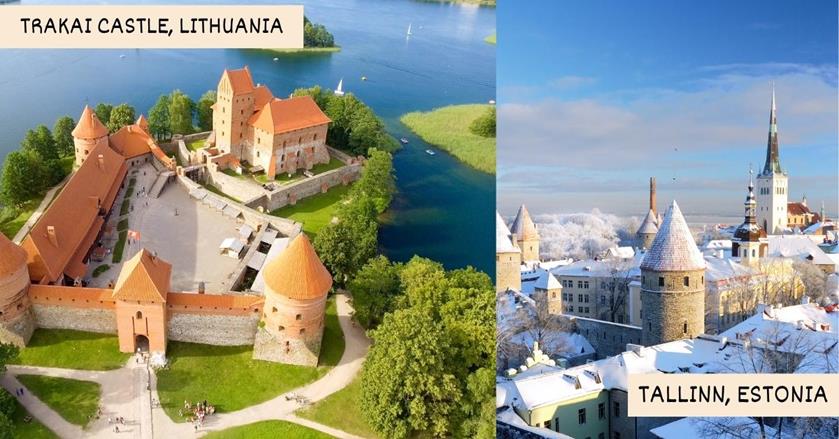
I have my usual favourites such as Italy, Scandinavia, Lithuania, and Slovenia. But I can’t help but want to visit new places.
If you’re in the same boat as me, the best way to narrow down where to go in Europe for 2 weeks is by looking at the map and knowing what you want to do.
For example, you love history and art. For those, you definitely consider Italy, France, and Spain. Interestingly, these are also awesome food destinations.
But let’s say you want to do hiking, then you should look at Slovenia, Norway, Portugal, and the UK. But France is good for hiking too, but I find it too expensive.
If you’re looking at affordable destinations, Eastern Europe is the place to go. There, you have the Baltics, the Balkans, and Southeast Europe.
Another way to choose is to check the flights. If you’re coming from Asia, most direct flights are landing in Spain, France, Italy, the UK, and Greece. Flights to those destinations are more affordable.
And finally, if you want to visit more than one country, choose destinations that are near one another. This means that you can get from one country to another either by bus, car, or train.
In this situation, France and Italy are great. Croatia and Slovenia are good too. Romania and Bulgaria are affordable. Estonia and Finland are just a ferry hop from one another. Belgium and the Netherlands are super close to each other.
You can check all our 2-week European itineraries in this collection.
When is the best time to go to Europe
This depends on what you plan to do. Most people go to Europe during summer, but of course, if you want to ski, come between December and February. I personally love going in spring and summer, during autumn, it’s also very pretty but it rains a lot.
You might want to consider travelling during the off-season or shoulder season (March to May and September to November). This is when there are fewer travellers and the prices of accommodations and tours aren’t sky-high so you’ll be able to save quite a bit.
Getting around Europe
The best way to get around Europe is to rent a car especially if the country you’re visiting are next to each other or have an open border agreement. It’s cheaper and gives you freedom of your time.
However, if you are crossing countries and they are not next to each other, you are probably better off flying than doing a long drive. Check first if your driver’s license is valid in Europe and check what type of cars each country you are going to have.
For example, Italy, Spain, and France are known for using a stick or manual transmission. While the UK and Ireland drive on the left.
Buses and trains are quite reliable and affordable and their schedules are integrated into Google Maps (most of them, not all). The train is my favourite way to travel around Europe. It’s affordable, and reliable most of the time, and you can walk around instead of sitting in a bus or car for hours.
But there are also domestic flights which are affordable as long as you don’t pack too much unless you are willing to pay extra.
Ride-hailing apps are common in Europe, but each country has their own. Uber , Lyft, and Bolt should be available in most European countries. To be sure, quickly look app “ride-hailing apps for X country”.
But there are also apps for using “public escooters and bikes” such as Lime and Bird. Install these apps and set up your card for ease of use.
You need comfortable shoes
Travelling around Europe means walking around a lot – on uneven surfaces. It’s known that most European cities are walkable, but covered in cobbled stones.
Make sure that you bring shoes that you’re comfortable walking on all day. For my recent month in Europe trip, I walked 20,000 steps on average every day for the entire trip.
Don’t bring new shoes. Instead, break into them a week or two before your trip by walking at least 5,000 steps a day.
Language and currency
There are over 24 official languages in Europe. You should be able to get around with English but it’s important to also learn basic words to show respect for each country’s culture and easily communicate with locals.
You should also install a translation app. If you’re sticking to popular cities, you won’t really need it. But for off-the-beaten-path and rural areas, it can be helpful.
Luckily though, most countries in Europe use the Euro, except in the UK, Nordic countries, and maybe some countries in East Europe.
It’s easy to pay with bank cards, and tap or contactless payment is very common. But carrying cash with you for emergencies is still advisable.
When getting cash from an ATM, avoid the machines that say “Euronet”. This ATM had higher fees and offered the worst conversion rate because it’s not a real bank. This means that this company makes money from ATM fees and conversion rates.
Instead, look for a real bank ATM. You can easily look up on Google map “banks” and it will show which banks are near you that will surely have an ATM.
You can also avoid all these by getting Euros in your home country from your personal bank. Get them in small bills, such as in 10s, 20s, and even 50s – but don’t get notes in 100s or 500s.

Buying sim card in Europe
Do you need it? My answer is it depends. Travellers from North America and Oceania usually have good deals from their phone company at home and that’s good enough than getting another sim card.
If you’re from Europe or the EU, it’s very possible that your sim card will work anywhere in Europe and pretty much no extra fees.
But visitors from Asia, Latin America, and Africa don’t. In that case, it’s better to get a local SIM card that works everywhere in Europe.
Another thing is the length of your trip. 2 weeks in Europe is not much, but if you are going to rely on your phone for navigation, translation, and even payment (phone tap), it’s better to have constant and reliable mobile data.
Regardless, the cost of a sim card with data is pretty much the same all over Europe which is about €35 for a 10-15 GB valid for 30 days. These sim cards should work everywhere in EU, but it’s best to ask the seller beforehand.
You should be able to get a sim card at the airport or downtown (just type on your Google map “sim card”).
Personally, I started using esims which you can buy online. It’s pretty much the same price and I don’t have to spend an hour or two comparing prices from one store to another.
Visa
Each country has different visa rules. However, if your destination is an EU member, they have the same visa policy; 90 days visa-free for visitors with a passport from North America, some Latin America, some Southeast Asia and East Asia, and most Oceania. This also applies to non-EU countries such as Switzerland and Norway.
For visitors with a passport from the EU or a European country, you should have freedom of movement for unlimited time except for some nationalities such as the UK and countries in East Europe.
If you need a visa in advance (Schengen visa), you can apply for one as early as 6 months before your planned departure date. You should apply from the embassy of the country you’re landing or starting your trip.
What is the average cost for 2 weeks in Europe
As diverse as the European culture is, the cost also varies a lot. The budget for 14 days in Europe depends on a few things such as the countries, type of tours, accommodation, and how you plan to move around.
$800 in Eastern Europe will not work for Scandinavia. $800 is a tight budget, but it might work for more affordable countries such as Eastern Europe or the Baltics (assuming this excludes the flights to the region and back).
$1,000 will be fine for Southeast Europe, and $1,500 will be decent for Central Europe. While West Europe and the Nordics plan to spend around $3,000.
The accommodation will be the most expensive, but the food can be budgeted. Then the transportation.
You can either use public transport or rent a push bike when moving around the cities. Take the bus or train when travelling to the next country or ride a plane.
Travelling during the peak season will also cost a lot more. The peak season is during summer which is between June to August. During Christmas, prices are also higher.
I prefer during the shoulder season, which is spring and autumn time. The temperature is also warmer, but the prices are still decent and the crowd is tolerable.
But to give you a bit of a ballpark here, plan to budget about $120-$150 a day per person. This amount sits in the mid-range.
NOTE: Prices are in USD.
Safety
In general, I find Europe safe. However, that’s not accurate for all countries. Rome, Paris, and Madrid are known for skilful pickpocketers.
In this situation:
- do not carry your passport with you when outside the hotels
- bring 2 bank cards, carry one that you can easily lock or cancel if gets stolen or one that has a low balance or low credit limit
- always put your hand on top or front of your purse/bag’s zipper when riding a bus/metro
- check your bus/metro/train seat that you didn’t drop anything before getting off
- wear a fanny pack inside your shirt
- know your embassy’s address and hotline for emergencies
- know the local hotline/emergency numbers
- don’t go with strangers to clubs/bars alone
Other basic travel tips
Planning a trip can be exhausting and often overwhelming. To make it a bit easier, I use travel sites and services that have flexible cancellation policies in case I change my mind or my travel dates.
Here’s a list of travel tools I use. From flight selections, affordable hotels, wide-range options for car rentals, and even affordable travel insurance.
When to book stuff
Whether you’re coming during peak or shoulde season, it’s always best to book your hotel in advance. I recommend 3 to 6 months in advance and book one that you can cancel for free or for a small fee.
I always use this site because I have so many options and the ease of searching. Not to mention that I can cancel at the last minute without paying for anything.
You can book something in advance if your plans are not set in stone yet. Then you can cancel them and book the one you really like once your plans are getting more concrete.
For the trains and buses, you can book a week before your trip or even when you get there. It’s cheaper if you book in advance, but if you prefer to wing it, that works too – you might just have to pay a bit more.
When it comes to car rentals, I like to book early too so I can get the best deals and have more options. This is even more important if you want to drive automatic cars.
Many cars in Europe are manual, especially in hilling France, Spain, and Italy. To ensure that you reserve and snatch one of those automatic cars, book the car rental early.
For tours, it all depends on the attractions. For popular sites such as the Colosseum, Eiffel Tower, Acropolis, and Pisa Tower to name a few, it’s best to get your tickets in advance.
This is because the tickets for these places are limited per day. I only had one day in Athens and I almost missed my chance to see the Acropolis. I was planning to just start my day and get the ticket when I got there.
But to my surprise, the next ticket available is not for another 2 hours and there are only a few tickets left.
On the other hand, for smaller attractions like the Nyhavn boat in Copenhagen or Postojna Cave in Ljubljana, you can get tickets on the same day or the day before.
SUMMARY OF HOW TO PLAN A TRIP TO EUROPE FOR 2 WEEKS
Planning a trip to Europe can be challenging because there’s so much to see and do and each country has different rules in terms of transportation.
I hope that you found this list of tips on how to plan a trip to Europe for 2 weeks helpful.